What is a second subsidy for Bitcoin miners?
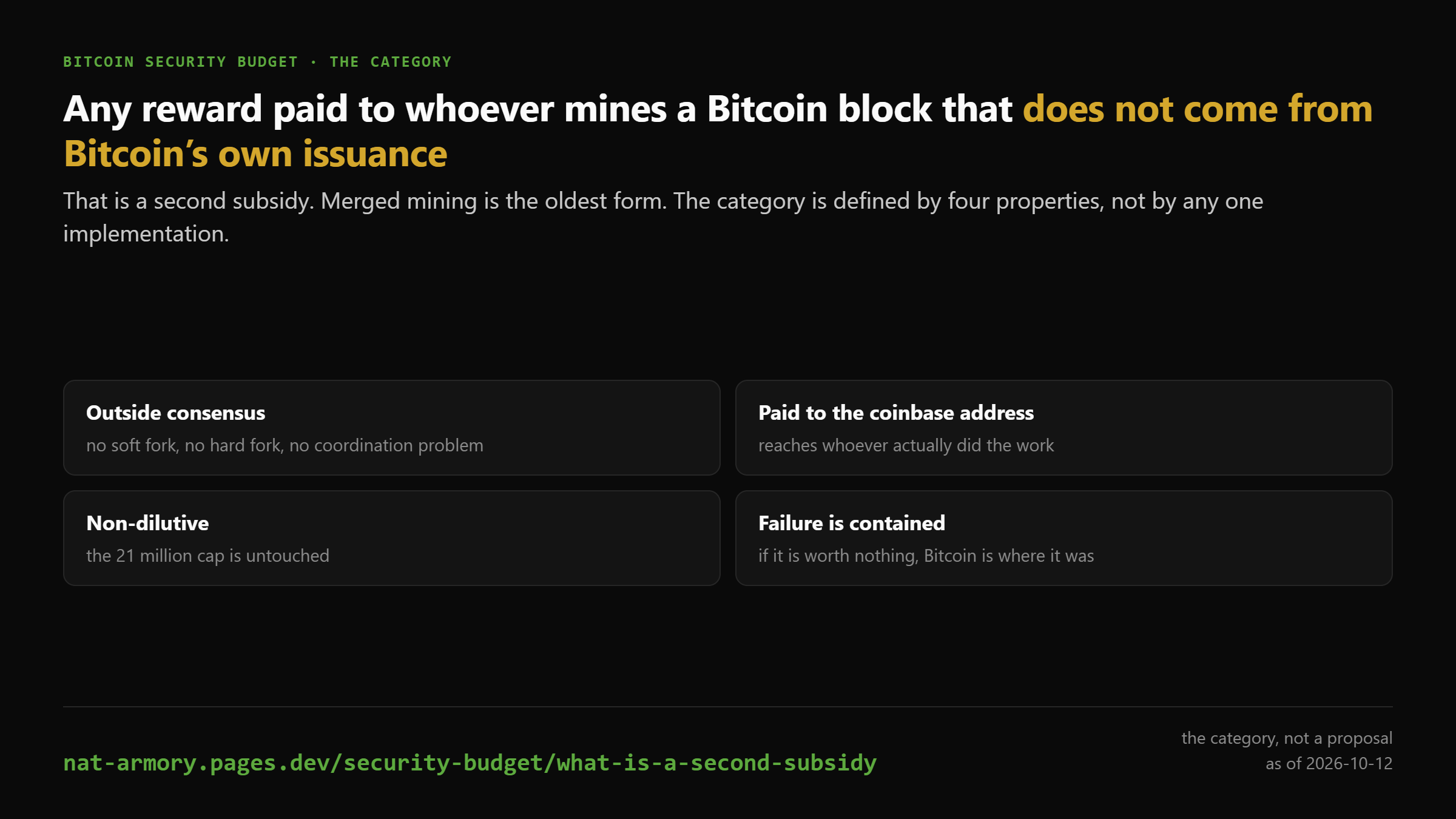
A second subsidy is any reward paid to whoever mines a Bitcoin block that does not come from Bitcoin’s own issuance. It sits outside consensus, so it needs no protocol change and cannot dilute bitcoin — and it can fail without taking anything with it.
Why the category exists
Bitcoin’s security budget falls from 0.82% of market capitalisation a year to 0.41% after the 2028 halving, on schedule and regardless of price. Every in-protocol answer to that requires either a consensus change or fee growth of about 31× today’s level. A second subsidy is the class of answers that requires neither, because it does not touch Bitcoin at all.
The defining properties
| Property | Why it matters |
|---|---|
| Outside consensus | no soft fork, no hard fork, no coordination problem |
| Paid to the coinbase address | reaches whoever actually did the work, not a subset |
| Non-dilutive | the 21 million cap is untouched |
| Failure is contained | if it is worth nothing, Bitcoin is exactly where it was |
Merged mining, the oldest form
Merged mining lets a second chain accept Bitcoin’s proof of work, paying its own issuance to Bitcoin miners for hashing they were doing anyway. Namecoin has done this since 2011. The idea that miners can be paid by something other than Bitcoin is therefore older than the security budget debate itself.
What the category cannot claim
Its weakness is exactly its strength inverted: a reward from outside Bitcoin is worth whatever a market outside Bitcoin says it is worth. That is not a guarantee and cannot be made into one. A second subsidy is a supplement that might work, not a fix that must. $NAT is one implementation; how much of the gap it could cover is arithmetic on its market capitalisation, not a forecast.
Who is claiming it, recomputed independently
The share of blocks mined by pools that claim the $NAT credit is recomputed on Dune from Bitcoin’s own block headers (coinbase tags and the bits field), by a query anyone can open and fork. It is the same figure the pool tracker shows, from a different computer.
Dashboard: dune.com/bitcoinsecuritybudget/bitcoin-second-subsidy. Base query: NAT emission per block.
This page as a shareable image: second-subsidy.png — 1200×675, with this address and the as-of date in the picture.