 $NAT · BITCOIN'S SECURITY, TOKENIZED
THE NAT ARMORY
One link, every weapon.
The Case
Start here. The thesis, interactive — read it before you argue it.
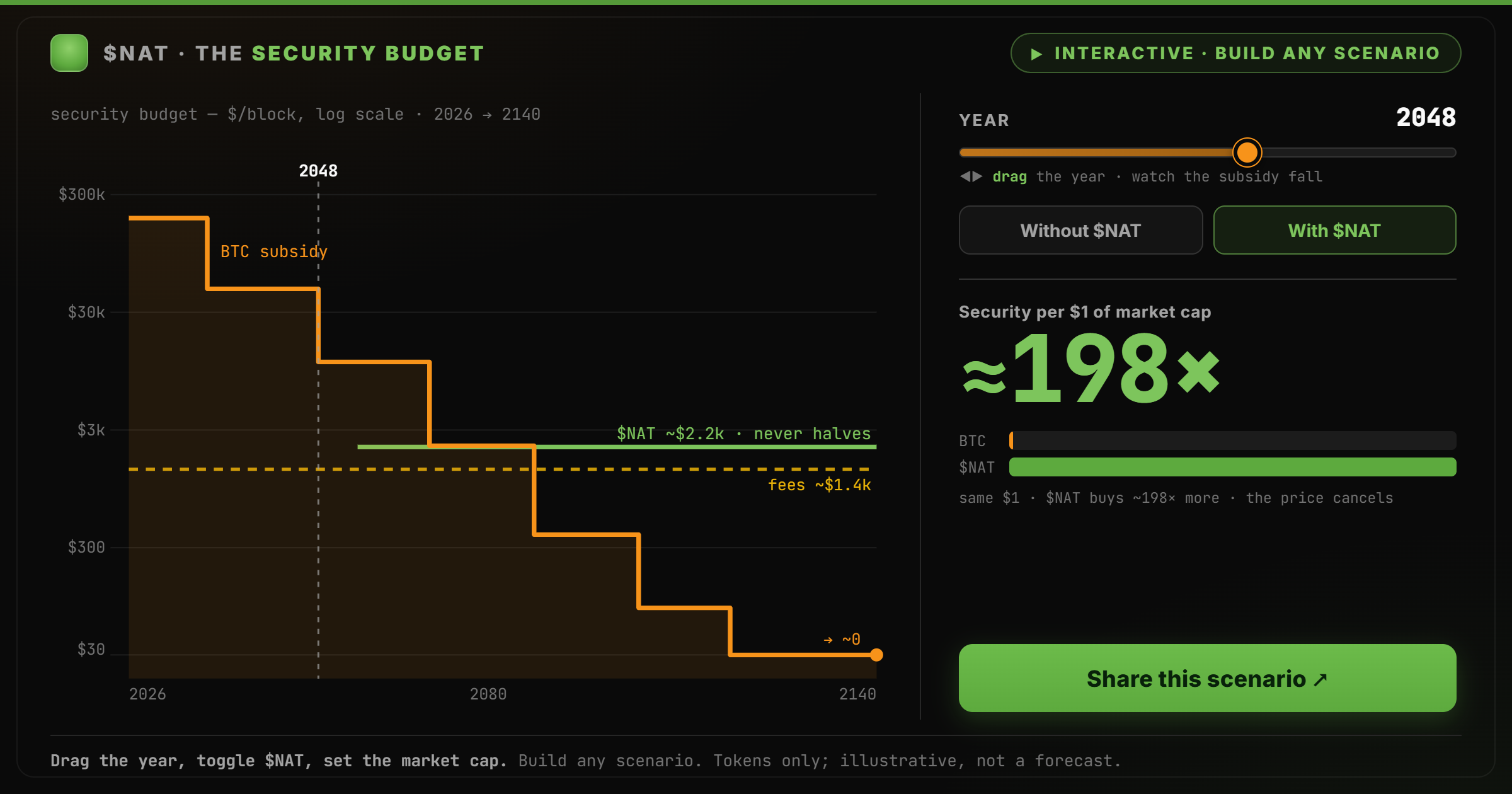
The security-budget cliff, interactive — the whole case in one scroll, halvings to fee gap. If you send one link, send this one.


The Ammo
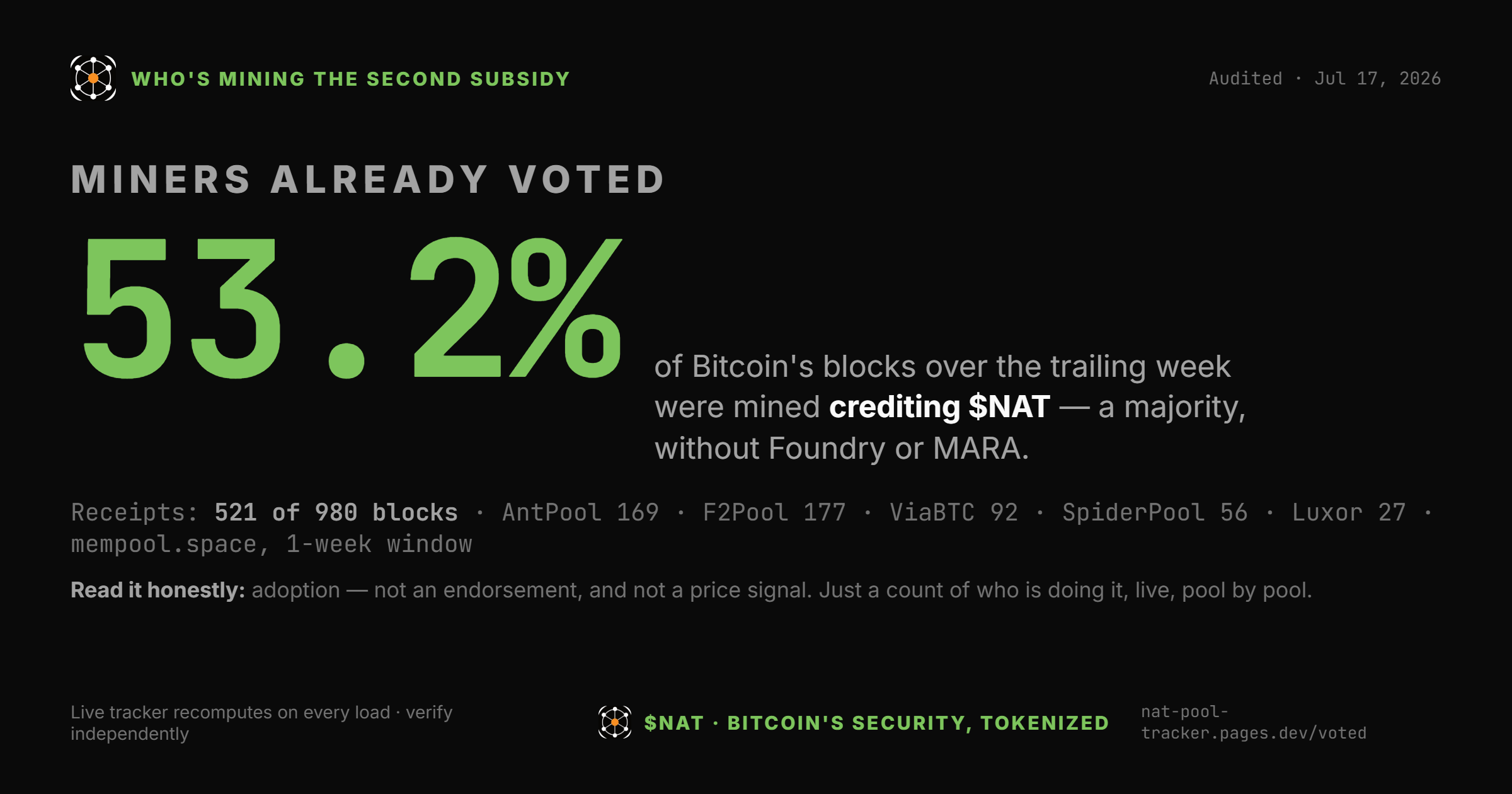
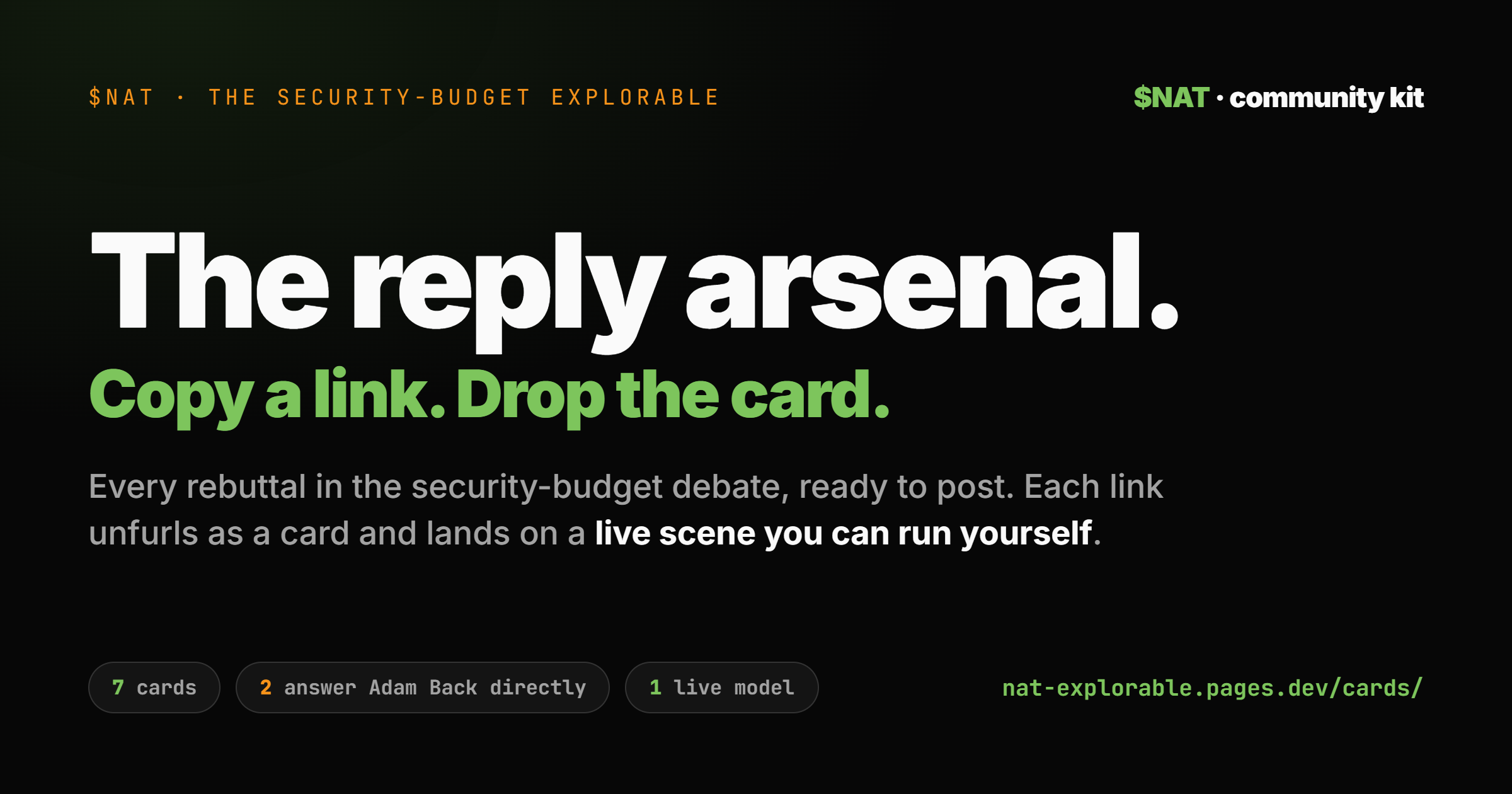
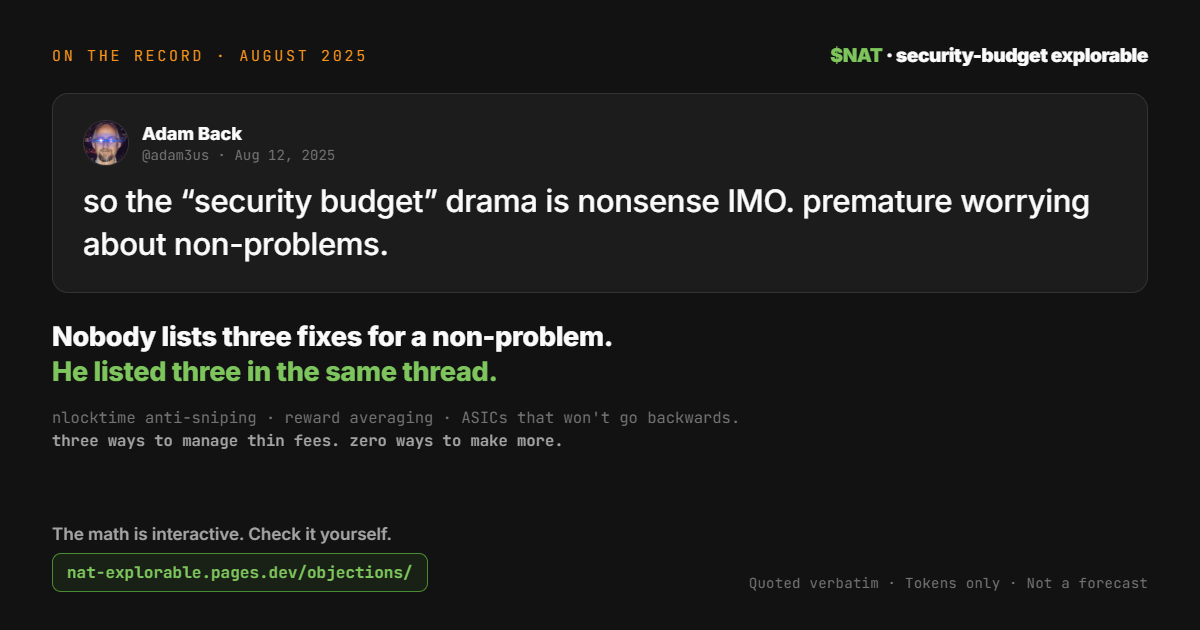
The reply kit. Copy a link, drop the card — never argue in your own words what a card already says better.
The Wall
The problem, in their words — we didn't invent the security-budget question.
Sourced, verbatim statements on Bitcoin's long-term security budget — from Satoshi to peer-reviewed research. Every quote links to its live source.
In a few decades when the reward gets too small, the transaction fee will become the main compensation for nodes.
Translation

Once a predetermined number of coins have entered circulation, the incentive can transition entirely to transaction fees and be completely inflation free.
Translation
something more like 0.5% to 1.5% of market capitalization spent on security would probably be appropriate.
Translation

I think there is general agreement that Bitcoin's long-term thermodynamic security is an important issue that's currently up in the air with regard to sustainability.
Translation

Look at the whole security budget of Bitcoin, which is I think the bigger question people should be talking about with all of these miners pivoting … transaction fees were meant to compensate miners for the halving. Well, that isn't happening.
Translation

Today power is the thing … which is why ourselves and many of our peers have pivoted, because you get a lot more money per electron if you're doing it for AI than for Bitcoin mining.
Translation
My concern level was like a eight or ten back in 2024 … we need users, we need customers, people to use this thing … and right now nobody's really doing that.
Translation

My answer right now, it's probably about like a five, but it edges up every year — I think within six years' time it'll be an eight.
Translation

Personally, I'm pulling out the champaign that market behaviour is indeed producing activity levels that can pay for security without inflation, and also producing fee paying backlogs needed to stabilize consensus progress as the subsidy declines.
Translation
Posted 21 Dec 2017 — the day before fees peaked at ~78% of the block reward. Within weeks they fell back to a small share.

the recurring, 'flow', payments to miners for running the blockchain must be large relative to the one-off, 'stock', benefits of attacking it.
Translation

With only transaction fees, the variance of the block reward is very high … and it becomes attractive to fork a 'wealthy' block to 'steal' the rewards therein.
Translation
If a robust blockspace market doesn't develop, we explain why a decline in block rewards poses a substantial risk for the future.
Translation

Bitcoin's “security budget” is the total amount of money we pay to miners … When this value is low, 51% attacks are cheap.
Translation

Bitcoin's block reward is scheduled to decline to zero, raising concerns about whether the network can remain secure once miners rely solely on transaction fees.
Translation
If mining is not profitable due to a high cost and low reward, miners lose their incentive and will stop mining, reducing the security of the network.
Translation

Monero … they put a lot of work into that tail emission and they're still regularly 51% attacked … in six years' time, another two halvings as a percentage of the total amount of emission of the coin, Bitcoin emission rate through the subsidy will actually be less than Monero's tail emission as a rate over the total amount being secured … to me, mid to longer term, this is a more important issue than quantum itself.
Translation
we have a static cap on the amount of block space and it’s in no way adaptive … somebody develops a killer app … and it is wildly successful, but eventually that use case will price itself out of the market because the supply of block space does not increase ever … eventually its own weight will crush it
Translation
fees are always difficult to predict, but I believe they will stay at a fundamentally low level … whenever I do financial models, I always plug in 0.35 Bitcoin per block
Translation

And there is nothing that you can do to the code of Bitcoin that addresses this problem. Literally nothing.
Translation

the amount of time that we have to resolve that question is not much … two halvings from now, you’re going to have a pretty drastically reduced subsidy, that’s seven and a half years away
Translation

markets go and do what markets do based on incentives … the way mining works is that it becomes unstable when all of your revenue comes from fees … No other cryptocurrency has ever actually survived this transition.
Translation

Whether you think about the stock model or the threshold model, Bitcoin right now is probably not prepared to transition away from the issuance-led regime … So, something may have to change.
Translation

The threshold model … is that there's some level of sort of annualized security spend at which Bitcoin is safe, and, you know, the problem is that we don't really know where it is.
Translation
in the absolute worst case scenario of a sustained 51% attack … If SHA256 must be abandoned, so be it. … Bitcoin could fork onto a different mining algorithm … I want to be clear, this would be a last ditch effort, and by no means guaranteed to succeed, but the simple fact this could occur may dissuade a nation state from trying such an attack.
Translation

There is a nuclear option here as well … it would be possible for participants in the network to say, we want to change our proof of work function … That's a nuclear option, which would be very contentious, because … that's a fundamental building block of Bitcoin.
Translation

Some blocks are going to be very lucrative, and some blocks are going to be relatively impoverished … when this variance increases, we concluded that a lot of the incentive alignment in Bitcoin might go haywire. Miners might be incentivized to actually go against the interest of the overall system.
Translation

when you combine a big debt burden with a marginally economic business, which Bitcoin mining is today, it made sense to return those miners and extinguish that debt.
Translation

to date 99% of the revenue from mining, which goes into paying for security has been the Coinbase reward. And that’s going to go to zero. … I think that’s a design flaw of Bitcoin. Fundamental design flaw.
Translation

So in conclusion, I think we need better arguments for when Bitcoin is economically secure. And when it’s not, we need to formalize this folklore of a community response.
Translation

But the more people are seeing Bitcoin as a treasury asset, a reserve asset, something that you don't spend, it's something to save and not actually use, the fewer transaction fees are actually generated.
Translation

Bitcoin's block subsidy is trending towards zero. It's an undeniable fact that at some point the block subsidy is going to be zero. So what's going to actually sustain and incentivize Bitcoin's on-chain security?
Translation
I think we crossover within five years. … 15 years from now, subsidy is irrelevant and it never gains relevancy again.
Translation

There's dwindling subsidy, I think, is a big one in like medium, long term. … The security of the system is directly proportional to the fees that people want to pay.
Translation

If that drops down to say 20 basis points, 10 basis points, maybe even lower … It's just a different system. It's a different protocol.
Translation

some people will say like, Oh, if hash power keeps going up, the system is more secure. And that's not strictly true. … It's all about the amount the miners are spending, right?
Translation

The fastest one we need is just one year and to fully convert into AI. The longer ones will need to take like two or three years.
Translation
there’s lots of different options … it’s just good to be open about the discussion and to not sort of cut it off.
Translation

So an attacker at 26% knows for a fact that it’s going to succeed.
Translation
Quoted on the problem — not the product. No endorsement implied. Each excerpt is a short, verbatim quotation of a published statement about Bitcoin's security budget. Inclusion here does not imply any author agrees with, or is aware of, any particular solution. Photographs identify the author of a quoted statement and are used for attribution only.